Built by Jeremy Avalos. A modular TypeScript / Node.js architecture that interprets prediction markets, tests executable opportunities and evaluates its own decisions. Experimental models and controls do not guarantee returns or prevent every loss.
01 / THE CHALLENGE
Make every entry earn its place.
A promising market is only a candidate. Discovery, parsing, liquidity, probability and risk are independent checks before an order can proceed. The engineering challenge is turning noisy real-time inputs into traceable, constrained decisions.
02 / ARCHITECTURE
Independent engines. One controlled flow.
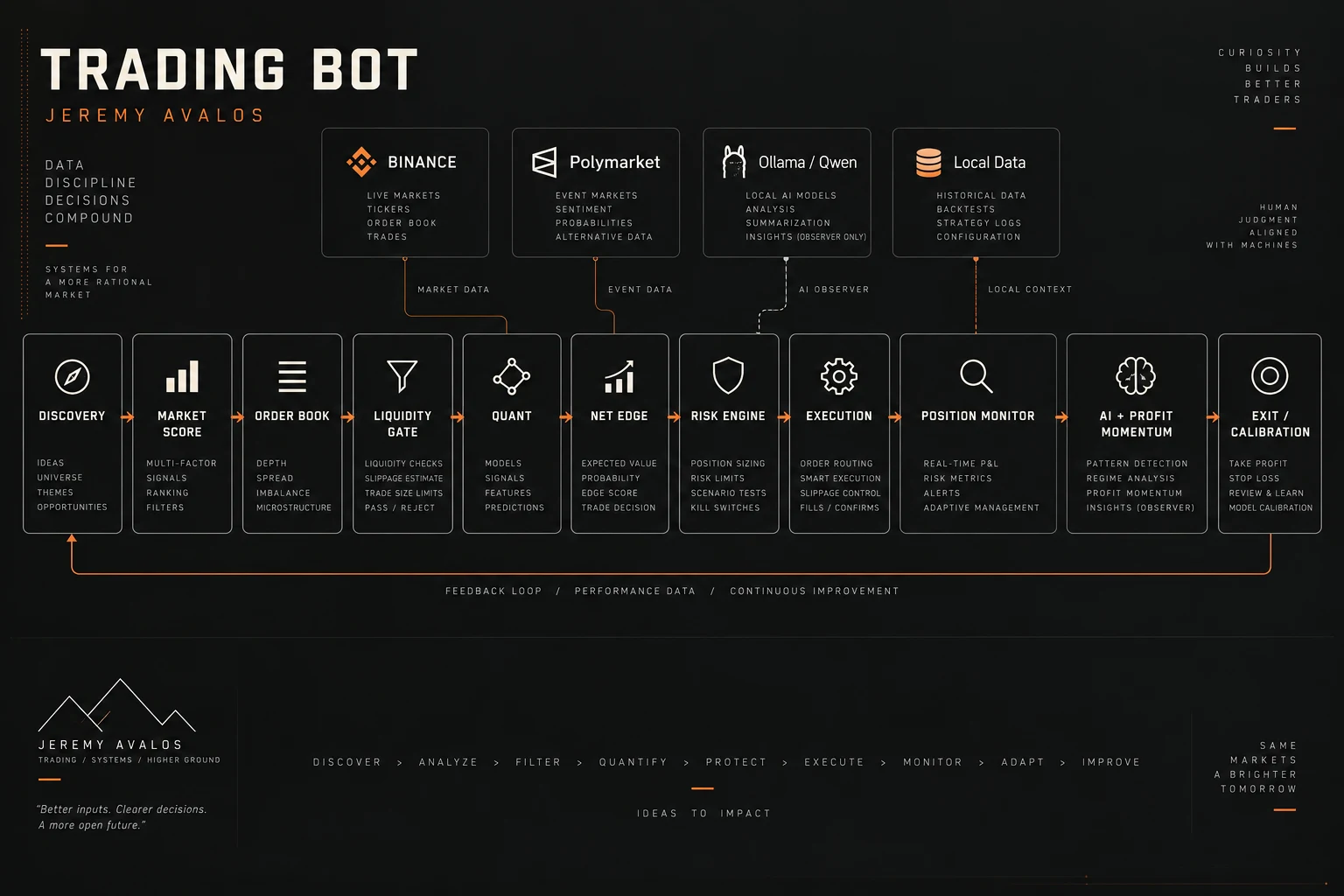
REST APIs connect Polymarket API / CLOB execution and Binance market data to modular analysis engines. Position monitoring feeds exit controls and durable evaluation datasets.
03 / MARKET INTELLIGENCE
Interpret the question. Verify the market.
Discovery ranks markets approximately every five minutes. A high score alone never authorizes a buy.
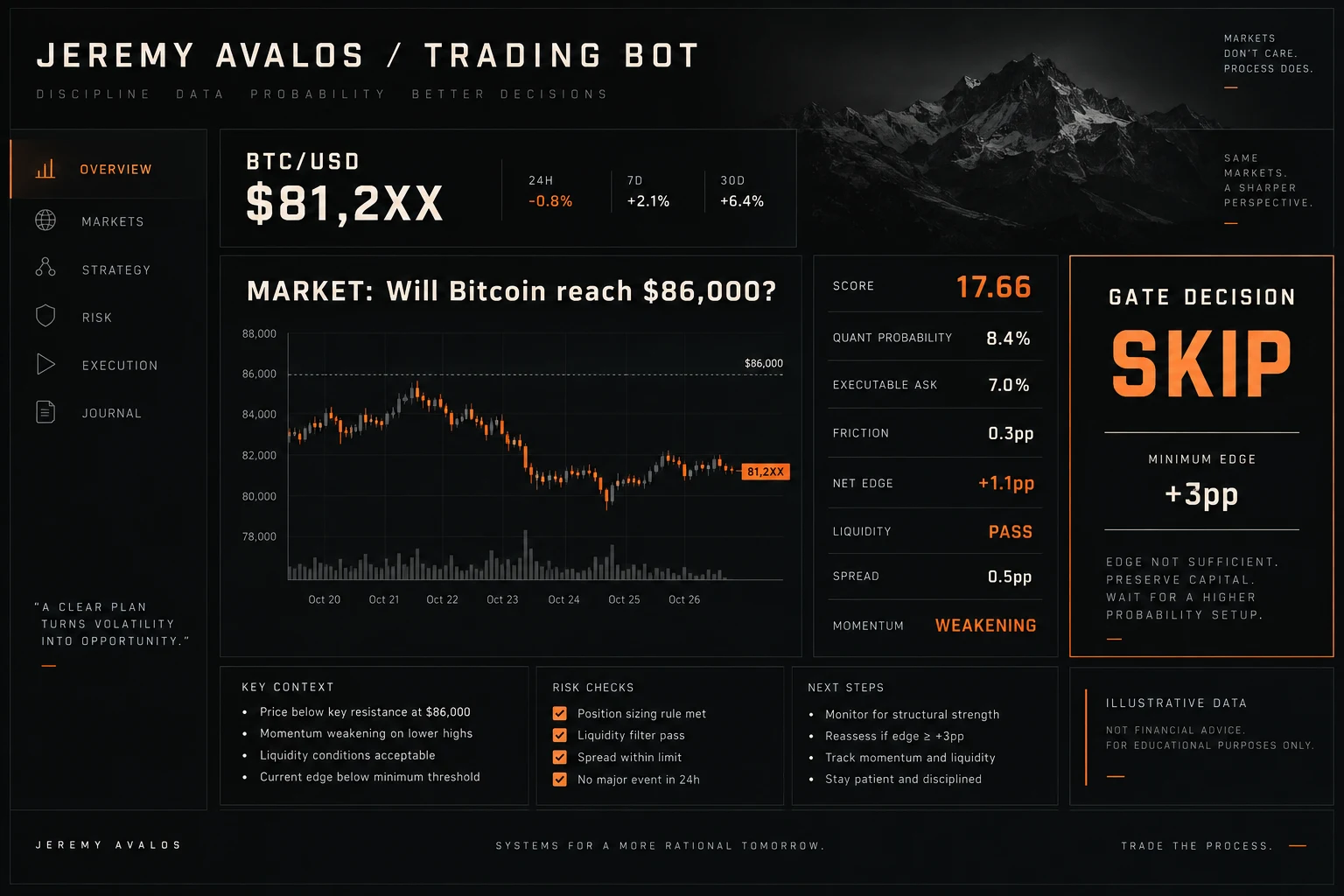
The BTC / ETH parser extracts asset, target, UP / DOWN direction, deadline, exact-day windows and date ranges. For example, “Will Bitcoin reach $86,000 September 14–20?” becomes a bounded barrier event. For exact-day markets, Binance one-minute candles can verify whether the barrier was already reached within that window.
The real order book provides best bid, best ask, spread, depth, tick size and minimum order size. Entries use executable prices.
04 / QUANT + NET EDGE
Probability has to justify the price.
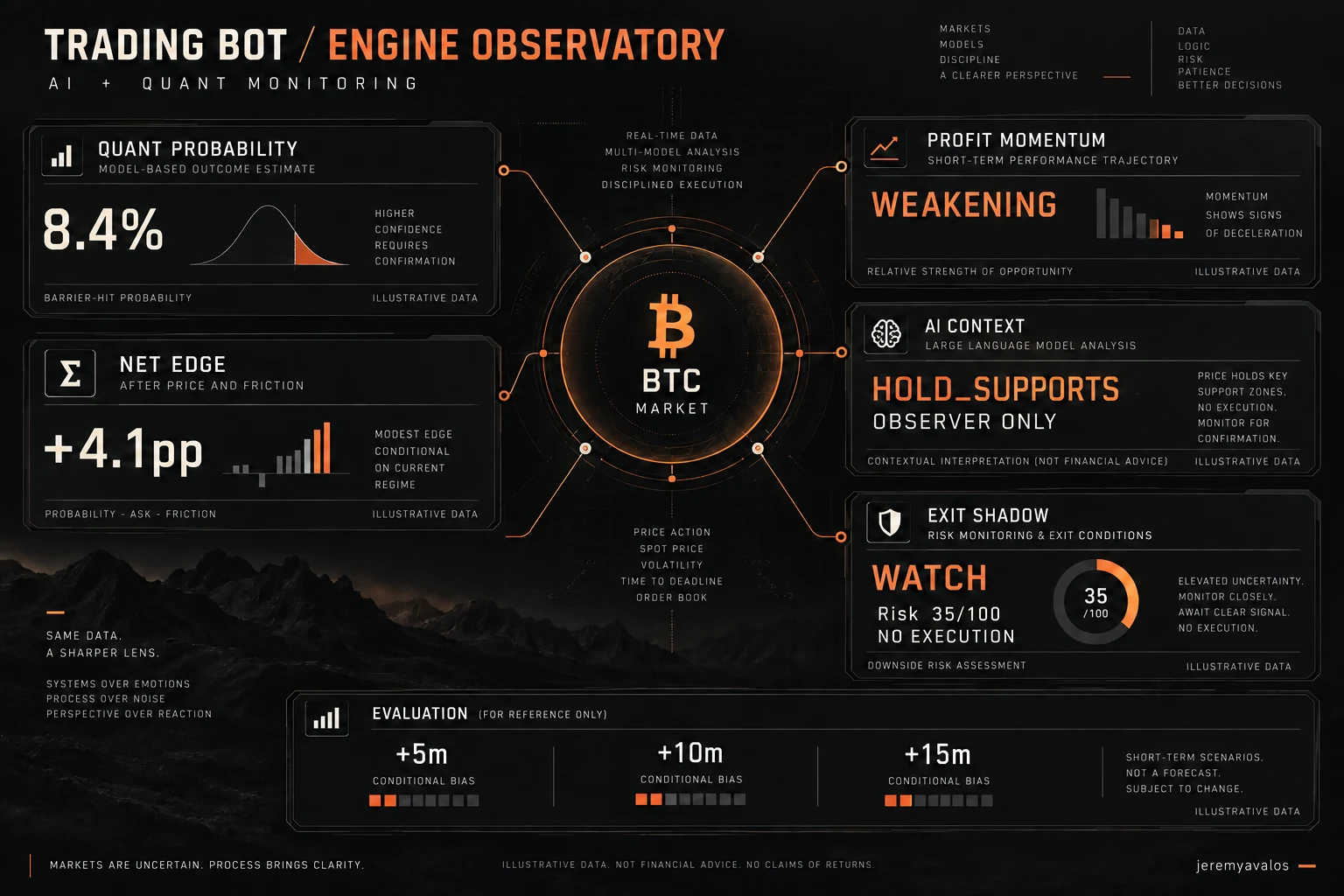
The quant engine estimates barrier-hit probability from spot price, target distance, time remaining, volatility, historical behavior and estimated drift.
Model probability − executable market price − estimated friction = net edge
The current experimental entry threshold is approximately +3 percentage points. A low price alone is insufficient.
HIGH SCORE + LIQUID MARKET + INSUFFICIENT PROBABILITY → SKIP
05 / AI INTEGRATION
Local intelligence, deliberately an observer.
Qwen runs locally through Ollama, using NVIDIA GPU / CUDA when available. It adds technical and market context for candidates and open positions: HOLD_SUPPORTS, WEAKENING, EXIT_RISK or UNKNOWN. It does not independently buy or sell.
A separate Profit Momentum engine combines 1m / 5m / 15m RSI, trend, relative volume, ATR and timeframe agreement into STRONG, STABLE, WEAKENING or REVERSING states, primarily for observation and calibration.
06 / RISK & EXECUTION
Protect entry quality and bound exposure.
The liquidity gate blocks entries when absolute spread exceeds approximately 1.5 percentage points or relative spread exceeds 20% of ask, limiting exposure to immediately adverse marks in wide books.
Available account capital is synchronized before sizing. An approximately $5 position target adapts to capital: $25 → 20%, $50 → 10%, $100 → 5%, subject to a maximum risk percentage.
Stop loss, profit lock, hard and trailing take profit, and time-based profit extension manage positions. Pending BUY limits, consecutive-loss pauses and exchange-error pauses constrain execution. An executed stop loss puts that market on an approximately one-hour cooldown, persisted across restarts, while other markets remain eligible.
07 / CONTINUOUS CALIBRATION
Evaluate the decisions, including the skips.
Entry Calibration records bought and rejected candidates, then checks outcomes after 5, 10 and 15 minutes to study whether different net-edge ranges identify better opportunities.
Exit Engine v2 runs in shadow mode: hypothetical HOLD / WATCH / EXIT decisions never execute a sale. It examines momentum, drawdown from peak, one- and five-minute bid velocity, spread and current P&L. Later observations test whether an alternative exit would have protected capital or closed too early.
The bot evaluates what happened after its decisions, building evidence for calibration rather than assuming its rules are correct.
08 / LOCAL INFRASTRUCTURE
Separate processes. Shared evidence.
Linux / Kali and tmux keep Trading Engine, AI Evaluator, Entry Evaluator and Exit Shadow Evaluator running as independent processes. The CPU handles strategy, APIs and analysis; NVIDIA GPU inference supports local Qwen.
Local persistence and JSONL datasets retain decisions, cooldowns and evaluation outcomes. Storage is deployment-dependent, with PostgreSQL / local storage as applicable. AI context runs locally while market data and execution depend on exchange APIs.
REST APIsJSONLtmuxCUDAQuantLocal AI
Parameters shown are approximate experimental settings and may change. Illustrations communicate architecture, not investment performance.